

Once upon a time, a mistake was made in the kitchens of
the Bastille. The error was so strange as to seem a miracle. This is what
occurred: on the day in question, a young prisoner received in his bowl, hidden
beneath the starvation-broth of prison, a raw turnip. The prisoner
marveled. The vegetable brought back to
him memories of freedom and meals along the Rue Chalet. Once, he recalled, he
had eaten a turnip with onion and pheasant, and another time mashed turnips
with sausages.
Slowly he drew forth the marvelous prize. He imagined the
crunch it would make beneath his teeth, and the thought filled him with joy.
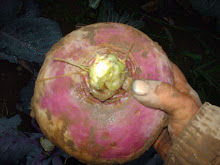
The vegetable was ellipsoid and more slender than most.
Studying it, the prisoner saw a vision of a man with coarse lavender garments
and a fiercely ugly face. Slowly he traced his fingers across the ridges. It
was a wise, knowing countenance, the sort that he had hoped to see on his
lawyer. Once he had had a lawyer. Now he was forgotten. So long had he been
alone that his clothing was mere shreds, symbolic of his hopes.
 The prisoner’s nails were long. He used them to take a
nick out of the turnip where the little man’s neck might be. The sliver of
vegetable tasted fresh and good upon his tongue. Working with concentration and
snail-like speed, he proceeded to free the little man’s head, and jacket, and
trousers, and feet, eating each scrap as it was cut away. At last the fellow
lay in his palm. An ugly man, but a unique one nonetheless. He called it
Socrates.
The prisoner’s nails were long. He used them to take a
nick out of the turnip where the little man’s neck might be. The sliver of
vegetable tasted fresh and good upon his tongue. Working with concentration and
snail-like speed, he proceeded to free the little man’s head, and jacket, and
trousers, and feet, eating each scrap as it was cut away. At last the fellow
lay in his palm. An ugly man, but a unique one nonetheless. He called it
Socrates.
***
Socrates had lived with the prisoner only a few days
before the aptness of his name was proven, for he possessed the ability to
rouse the prisoner’s mind from the hopeless torpor into which it had sunk.
“Once,” said the prisoner to his turnip, “I believed in
the equality of man. ‘Égalité,’ that was my watchword. Do you believe in the
equality of man?”
Socrates said nothing, but the ridges of his ugly face
showed that he pondered.
The prisoner admitted, “Perhaps it is a fantasy. The
brains and muscles of men are distributed entirely unequally. I myself ought to
have received more brains. My father is a clever man, and my brother is a
clever man, and even my nephews are clever. But I? I am an idealist, a man of
dreams and revolutions. People said at one time that my pamphlet was clever.
Yet what has it done for me?” He pointed to the stones around them.
Socrates also glanced about, but only as if to say, “Why
complain?”
The prisoner tried to make his point more plainly. “Their
God-given intellects enable them to sit at home in safety. By now they have
pawned my watch and sold my books. My intellect merely betrayed me into this
living grave. Is that equality? No, it is clear proof that men are born
unequal!”
Somewhere in the prison, a madman shrieked, and a key
ring rattled in a keeper’s hand.
The turnip whispered something, and the prisoner laughed.
“You claim that the material state does not disprove the spiritual, eh? The
mere fact that I rot here does not disprove my moral equality with his majesty
King Louis? Perhaps. In the realm of God there is truth without prison. Yet
here I sit. Be careful, my friend, or I will think that you are suggesting I
should hurry to the realm of God.”
 |
| (Image of the real Socrates) |
The turnip seemed to smile. It was a companionable smile,
but not a sympathetic one. What can a root vegetable know about the sufferings
of a sensitive human mind?
Slowly the prisoner exhaled. “Your nose reminds me of the
nose of Père Aboit, the schoolmaster. Do you know what he would say to me? He
would say that the ways of God are inscrutable. Once I told him that
mathematics are also inscrutable. He whipped me for impiety and insisted that I
memorize the common sums. You yourself, Socrates, are worse than he, for at
least he told me that six of six is thirty-six. You tell me nothing.”
The turnip smirked.
“You are infuriating! As bad as the real Socrates!
Forever questioning and badgering, yet never venturing an answer of your own.”
The prisoner drew himself up. “Who are you, to look at me thus? Here in this
cell you shall treat me as an equal.”
Yet as the days went on, the argument was not resolved.
Continuously did the prisoner implore his vegetable to cease with smirks, and
wise looks, and other subterfuges. He begged it to be free and equal and speak
as man to man. Yet it would not.
At last, the prisoner came to a realization. He had
expected too much of Socrates. How could a newly-carved turnip understand
equality, when it had never seen beyond the confines of this cell? How could
the ugly little man be free, unless he tasted freedom? The prisoner was
grieved. He had come to treasure his friend. Yet because of that love he must
act. He must send Socrates forth to feel wind and hear the chatter along the
Rue Chalet.
The next day, the prisoner hid his companion in the slop
bucket. It was not a fragrant way to escape, but it would serve. Socrates would
be taken away.
Life in the cell was lonely after that, yet no longer
bitter. The prisoner had found his philosophy. The equality of men, he
explained to himself, is in their equal ability to choose the good and noble
course. That was the equality which no prison cell or king could take from him.
Far off in the Bastille kitchens, slops and peelings were
being thrown into cauldrons. Steam rose. Somewhere a kitchen boy was weeping
because a guard had boxed his ear.
Yet in the cell of the prisoner, quiet reigned. The prisoner
was at peace.
END


