Showing posts with label Fairy Tales. Show all posts

Saturday, February 21, 2015

Cautionary Tales

I was talking with a friend about fairy tales lately. Among many other purposes, fairy tales once provided children with memorable warnings. The stories cautioned young listeners about certain aspects of humanity and about the necessity for humility and courtesy to strangers. When I wondered aloud whether a modern equivalent exists (do we tell cautionary tales to our children today, or just inspirational tales?) my friend pointed out that the modern world is full of cautionary tales. However, they are all for the parents.

Nowadays, it is generally the parents who are supposed to worry about strangers, dangers, and rustling noises in the woods. Not children. Children mustn't be exposed to darkness in their stories, lest they be alarmed. Not, at least, until they are old enough for the YA section.

I wonder why we do this. Being me, of course I think that all the adult cautionary tales and safety obsession is connected to other ideas, which are connected to other ideas, which show us what some of the problems in the modern world are. I'm working on an article about that.


Sunday, February 8, 2015

Learning to Be a Novelist


My manuscript is progressing. Right now I have about 13,000 words, and my modern-day heroine has been successfully kidnapped by a folktale queen.

I like this book quite a bit. My ability to control a story--cutting, adding, and changing in order to achieve the desired effect--has increased significantly in the last year. It’s exciting to be able to do things that that I didn’t use to be able to. I still struggle to achieve the layers of richness and nuance that I would like, though, so I clearly have a lot of work and learning ahead.

One interesting question that the class has raised is whether an author needs to "love" their protagonist. It seems that most of my fellow classmates do feel deeply attached to their main character. I like my heroine, but I don't know that I love her. Is this because I don't delve deeply enough into her personality? Is it because I keep her at (too much of) a distance from myself? Is it because I won't know her fully until I finish the book? Is it because I just don't attach as easily as some people to fictional creations? I'm not sure yet.

I submitted the first six pages in my novel-writing class, and look forward to receiving the teacher’s critique tomorrow (so far all feedback has been through peer-workshopping, which always raises an interesting variety of opinions).

My current plan for the novel is to begin each chapter with a brief quotation from a historic folk/fairytale. Each quotation relates to the events of the chapter. The use of quotations seems to draw forth a mixed response from my fellow students, so I’m curious: do you (intelligent readers of my blog) like quotations at the beginning of chapters, or do you find them annoying/pretentious/something else?

Wednesday, December 10, 2014

Gold Thread at Christmas


A short story by Anna Ilona Mussmann

This is something that I wrote two years ago and have recently edited. It's a bit of light fun, and no babies were harmed in the making of it. Merry Christmas to all my readers!


Shivering, the dwarf pressed both hands into his armpits. His summer jacket was as inconsequential here as if the void through which he had passed had spat him out naked. While he waited for the dizziness to pass, he scowled at the brick buildings that loomed upwards in their narrow lots—they filled him with a sense of puny unimportance. This world was tall and bland, full of unadorned cart horses and workmen in iced-over mustaches. He would be doing a favor to the child he had come to take.

Despite the cold, the dwarf unfastened the second to last button on his waistcoat before he selected assistance.

Two men trotted along the sidewalk, sprigs of holly pinned to their lapels. The open bottle that one of them clasped against his snowy shirt front seemed to be their defense against the cold. They, too, towered above him, glossy black hats increasing the contrast in height.

“I beg your pardon,” he declared, barring their path. “Can you gentleman direct me to the location of the royal birth?”

Two bewhiskered faces stared down at him. One guffawed, baring tobacco stained teeth. “What have we here? A circus midget? Better get back to your keepers, little fellow, or you’re liable to be mistaken for an organ-grinder’s monkey.”

“Look at him!” exclaimed the plump one. “Gold embroidery, red cap, the lot.”

Stepping backward, the small traveler cracked his hairy knuckles. “I beg your pardon,” he repeated grimly. “Do you intend to answer my question?”

“Loopy,” the tobacco-lover observed.

The plump one added more kindly, “This is a democracy, my small friend. We don’t hold much with royalty here.”

Wednesday, November 5, 2014

My Favorite Picture Books


Recently, while listening to the Read-Aloud Revival podcasts, I found myself wondering how I would answer the question, "If you were stranded on a desert island with your family, what three fictional books would you want to have with you?"

I asked my husband about this. We had trouble deciding. The problem is that the definition of "three books" is a little squishy. For instance, does the Globe Illustrated Complete Works of Shakespeare (a massive volume, to be sure, that would probably sprain your wrists if you tried to read it) count as just one book? The Chronicles of Narnia can also be purchased in a single volume. Does that count as only one? In which case, I'm sure that there are anthologies of British novels that would include multiple books.... Or perhaps I could get some of my favorite books bound into three large volumes. Maybe the problem is with us. Maybe we have the minds of people who cheat when they answer hypothetical literary questions.

A little later, someone asked me to come up with a list of three books that I would recommend for each of his two young daughters.

These mental exercises have resulted in my wanting to provide you all with a list of my favorite childhood picture books. These are the volumes that I would like to have to read to my children if we had no other picture books available, whether or not a desert island was our home. I did not manage to limit the list to a mere three, but it is still fairly short.

Tuesday, August 5, 2014

An Enticing Idea


I wrote a story this week in the style of a folk tale (I am still in the stage during which I think my story is very, very good indeed, purely out of authorly affection-- critical identification of its flaws will come later). My husband commented that the theme of the tale is actually quite Lutheran.

This gave me an idea.

Wouldn't it be delightful to write a book of original fairy tales from a Lutheran perspective, and see if CPH would publish it?

They would probably look with raised eyebrows at a query letter about fairy tales, but still!

Ha, if I ever write that story about the enchanted Book of Concord, it will of course take a place of honor in this volume.


Monday, April 28, 2014

Princesses Always Cause a Fuss


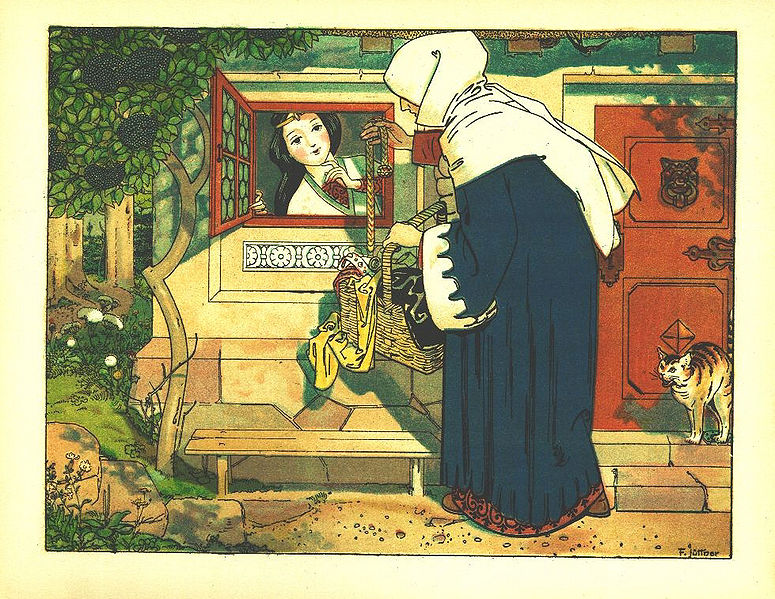
File:Franz Jüttner Schneewittchen 4.jpg

If you don't follow me on facebook, you may not have seen my Friday article in The Federalist.

Here's a quote:
Correlation is not causation, but I wonder if, in a broad sense, the cultural message of pink princesses ultimately makes girls more receptive to stories in which traditional happy endings are impossible. Initially, many small girls really believe the princess story. They live and breathe it, plastic tiaras and all. What is this message that resonates with them? On a basic level, it is of course merely human to be attracted to youth, beauty, success, and happiness, as demonstrated by the friendly smile of the white-toothed heroine and opposed by the scowl of the witch. It is also the nature of a three-year-old to believe that she is not only special but also probably the center of the universe, that she should be served by admiring retainers, that she is the best at everything, and that she should win the prize in every competition. The princess fantasy lures little girls in with shiny rhinestones and simultaneously tells them everything that they already believe. In a sense it is developmentally appropriate. However, the job of adults is not merely to mirror children back to themselves. Our job is to help them mature and grow beyond the narcissism of babyhood.

It's interesting that discussion of little girls and princesses always seems to bring out strong feelings and lots of opinions. Another article ran in The Federalist today about how the author has made her peace with Disney princesses

I am beginning to think that part of the disconnect we see in such discussions is centered around a confusion of what princesses represent. To feminists, they are merely oppressed and spineless women who require a man on a white horse. To anti-consumerists, they are merely plastic merchandise that generates a gazillion dollars. To psychologists, they are often an example of how we prime girls for body-image issues. To defenders of traditional femininity, they may be examples of good, old-fashioned romance and chivalry. To parents of small girls, they may be simply something that their children love. 

I don't think that all of these people are talking about the same thing.

I love folk tales and tales of the fey. There are plenty of lovely, true, excellent stories in this genre about princesses. That is one kind of princess story. The movies of Disney are another. I like some of them in some ways (Tangled is hilarious). Yet the merchandise of Disney, in which all the characters lose their individuality and become products instead of characters, is not something that I want in my home. I'm just not going to buy my kid underwear that advertises for some company, ya know? I'm cranky like that. 


Tuesday, April 1, 2014

Yes, There Is a Right Way to Portray Fairies (and Why It Matters)


By “fairies,” I refer to the creatures who inhabit the unsettling tales of old legend, not those winged lawn ornaments of Victorian and modern art. I really mean “the fey folk,” “the people under the hill,” “the fair ones.” We need them, and I shall explain why.

The fey folk are dangerous. Disobey their instructions not to look over your shoulder, and your head might get stuck that way. Annoy them, and your cows may never give milk again. Go to one of their parties, and you might just dance until the flesh falls off your bones. They are not like humans: they do not feel love or pity. They are unearthly and amoral.

Yet they are also fascinating. Their powers are mysterious, their race appears immortal, and often they are more beautiful than any sight yet seen by human eyes.

The only reliable thing about the fey folk is that they are unpredictable. Sometimes they plague a farm with tricks and mischief, sometimes they exchange a human child for one of their own, sometimes they steal a man away to be husband to a fey, sometimes they give a woman rich rewards for having helped them. Cautious people avoid them. Sane people are always terribly polite to them. Unfortunate people are driven mad by them.   


The folk play an important role in the stories that shape our imaginations. It is important to remember the lessons of the fey:
1. Always treat strangers with courtesy and caution, because you do not know who (or what) they might be.
2. There are mysteries in the world that make life deeper, more frightening, more beautiful, and more exciting than it would otherwise be.
3. There are realms into which humans ought not to delve, and desires which humans ought not to satisfy, lest we destroy ourselves.

The last point is something very much needed today. We live in a world where the concept of Eve’s apple and Pandora’s box is hard to truly understand, because it is fashionable now to think that any taboo can be thrown off and any barrier broken. We are accustomed to choice and freedom and scientific discovery. We are bold enough to think that we will be able to understand everything about the human brain, or outer space, or love, or engineering humans in petri dishes. We truly believe that everything in the world is ours for our taking (and we probably even believe that we can custom-order it while we take it).

Tuesday, February 18, 2014

Review: Marisa Meyer's Cinder

New York: Feiwel and Friends, 2012
Young Adult

In futuristic Asia, the situation is bleak. A dreadful plague without a cure ravages the population, and the evil and powerful Lunar queen threatens the freedom of the countries on earth. Meanwhile, the royal prince is preparing for the annual ball and desperately hoping to uncover the true heir to the Lunar throne. This is one of those books that isn’t actually very good, yet somehow contains an intangible spark that makes a reader care about the protagonist.  The story’s weaknesses are all upfront: It is a young adult fantasy romance (not a promising genre). There are logical gaps that require suspension of disbelief. Its futuristic setting shows very little worldbuilding. In fact, even though a royal prince and international intrigue are involved, they are portrayed as they might be imagined by a historically ignorant ninth-grader.    

Yet something about the heroine—a orphaned, teenage cyborg who supports her unkind stepmother and her stepsisters by working as a mechanic in New Beijing—kept me turning pages. She is interesting. She makes me want to see her survive and succeed.

As a retelling of Cinderella, the tale is creative and imaginative. I enjoyed seeing how the source material was used and reinvented. After all, how often do you see Cinderella-as-cyborg? Cinder does end up going to the ball, of course, but her story is only begun in this novel. If I want to find out whether or not she marries the prince (and, more important to this retelling, whether the evil Lunar queen is defeated) I will have to read the other three books in the series. 

Read other reviews at What We're Reading Wednesday!


Tuesday, January 7, 2014

Four Books You Should Hear About (Cancer, Russian gods, Fascism, and Faeries)

(As I write this, the sound of gentle wheezing rises from my lap: the baby boy is sleeping there. He looks awfully angelic. I know that if I transfer him to his bed he’ll wake up, so I’m leaving him in place even though the ergonomics of my typing are a bit awkward).


My Recent Reading


The Fault in Our Stars by John Green (2012)

Front CoverI read this book while in labor. I probably should have stuck to lighter, more cheerful fare, but the vivid storytelling kept me going between contractions. The Fault in Our Stars is a highly acclaimed, well-written YA novel that is currently being made into a movie. It’s the sort of story that is guaranteed to bring forth adjectives like “real,” “gritty,” and “honest.” The teenage protagonist, Hazel, is afflicted with a deadly cancer. Convinced that Hazel is also suffering from depression, her mom insists that she attend a support group. There Hazel meets the love of her young and threatened life. As the two teenagers grapple with love in the face of death, they scorn the sentimental nonsense with which the adults around them treat cancer, and in the end, a sort of wry and existential courage is all that they can believe in.

This book is an extraordinarily believable portrait of how a brave, intelligent young person might respond to suffering and death. Hazel rejects the trite religiosity that is offered in her support group and in a church funeral. Such a portrayal of Christianity is unfortunate, but alas, it is realistic-- many kids have never been given anything better by their churches and youth groups. As an adult, I found The Fault in Our Stars a compelling but tragic story. Initially, I felt that I would not hand this book to any but the most mature teen. Reason one: the story makes existentialism and unbelief appear the intelligent choice. Reason two: young Hazel and her boyfriend sleep together. However, I may not be giving enough credit to young readers who are grounded in their faith. Perhaps there is no reason why they would not respond the way that I did. Perhaps this book ought to be read the same way we read books like the Iliad: as a truthful portrayal of non-Christian life that can help us to better understand our non-Christian neighbors.


Enchantment by Orson Scott Card (1999)

Friday, October 4, 2013

Yolen and Gaiman: Two Fantasies Reviewed

The atmospheres and intended audiences of these books are completely disparate. However, the two are linked by the fact that I  read them recently and thought that a review would be in order.


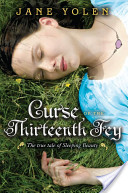
Curse of the Thirteenth Fey: The True Tale of Sleeping Beauty
Jane Yolen, 2012
YA Fantasy


I have a weakness for stories about the fey folk. This particular tale centers around Gorse, the thirteenth and youngest child in a fey family that possesses wings and magical ability. Gorse enjoys frolicking through the fields and studying her elven father’s enormous library of books (some of which are from the future and talk about strange mysteries like “computer science”). Unfortunately, her family is bound to the land of their king and must obey his every summons. Forced to work magic as requested, they reluctantly prepare to attend the christening of the new royal princess and to bring the requisite magical gifts. Gorse has the misfortune to fall into a magical trap that prevents her from obeying the summons. Not only does this put her entire family at risk, but it also lands her in the clutches of an unsavory, Unseelie prince who wants to use her to escape his own enchantment.

This story plays with folk and fairy tale conventions in a pleasant, light-hearted way. The fey folk (Seelie, Unseelie, and Family) are traditional enough to contrast well with the modern structure of the story. The Sleeping Beauty element is turned on its head in a manner that is not particularly unpredictable but is humorous.  Although the tale is light and fluffy, it provides a positive take on family love and loyalty, the importance of learning, and the unpredictability of prophesies. This is a harmless, enjoyable book that young teen girls would enjoy.


Tuesday, October 1, 2013

How Big Is Your Child’s Bubble? Weighing the Merits of Mainstream Fiction in a Classical Education


Recently, a friend asked me why I think it is O.K. for kids to read Harry Potter. This is the kind of conversation that can go in many directions, but is ultimately less about the specifics of J. K. Rowling’s work and is more about the proper role of literature in a Christian child’s upbringing. For me, it is also a discussion that highlights the philosophy of classical education.


First of all, why should fiction be part of a child’s mental and moral education at all? It would be possible to draw all stories from history and to spend the rest of the day on arithmetic, science, and theology. Theoretically, the child would thus be exposed only to truth instead of to imaginary people and their lives. Yet the physical information provided by science, arithmetic, and even history cannot fully explore psychological and spiritual realities and does not prepare the mind to grasp the intangible aspects of theology. Fiction is better than history at helping readers to explore the baffling, beautiful, and horrifying depths of human nature because fiction is an art form and is therefore free to arrange stories in whatever manner is needed to make truth clear. This arrangement can force the reader to think in new ways. It strengthens our ability to empathize with losses, sufferings, and triumphs that we have never experienced because it helps us imagine how they would affect us. It provides a safe way to examine the consequences of life choices without committing them ourselves. Fiction is needed because we humans were created with emotions and imaginations that arithmetic cannot fully satisfy. 

The classical education presents literature from throughout the scope of human experience in order to explore the great questions of life and to see how humanity's answers (whether true or false) influence our own culture. Simultaneously, these books shape the student’s taste by providing the best possible examples of literary and artistic excellence. In the classical model, then, books are chosen for three reasons: 

Friday, September 6, 2013

When the World Turns Grey: Two Juvenile Novels in Contrast

“I think it is possible that by confining your child to blameless stories of child life in which nothing at all alarming ever happens, you would fail to banish the terrors and would succeed in banishing all that can ennoble them or make them endurable. For in the fairy tales, side by side with the terrible figures, we find the immemorial comforters and protectors, the radiant ones. . . It would be nice if no little boy in bed, hearing, or thinking he hears a sound, were ever at all frightened. But if he is going to be frightened, I think it better that he should think of giants and dragons than merely of burglars. And I think St. George, or any bright champion in armour, is a better comfort than the idea of the police.” C.S. Lewis


Last week I read two juvenile novels with superficial similarities. Both could be called fairytales, and both center around parentless children who work for dishonest showmen. They prompted me to think about how juvenile fiction presents good and evil. How should an author communicate the messy reality of life without damaging a child’s sense of right and wrong? How grey can you go?


First, a summary of both books:


The Charlatan’s Boy
Jonathan Rogers, 2010
(Classified as Young Adult, but safe and simple enough for younger readers)

“… when it comes to knowing where you come from, you got to take somebody else’s word for it. That’s where things has always got ticklish for me. I only know one man who might be able to tell me where I come from, and that man is a liar and a fraud.”

Grady is an extremely ugly orphan who knows nothing about his own parents or origins. He travels with the fraudulent Professor Floyd and performs as a “Genuine He-Feechie Alive and in the Flesh,” the main prop of the professor’s lectures on the Feechie folk and their habits. However, as fewer and fewer folk maintain belief in the mythical swamp-dwellers, business dries up. Eventually the professor decides to fabricate a great Feechie scare in order to revive the once-lucrative trade.

Although the story takes place on the imaginary island of Corenwald, it is steeped in the vernacular story-telling tradition of the Old South. Grady’s language and outlook are engagingly atmospheric while remaining down-to-earth. His personality is appealing. Although he suffers from the isolation of someone who belongs nowhere and must deceive almost everyone, he is a kind-hearted soul who attempts to remain honest and who reflects on the nature of truth. He is also loyal to his unloving master because, as he puts it, he has no one else to love. Fairly simple in both plot and character development, the book is full of humor and a touch of melancholy. It would appeal especially to preteen and young teen boys.


Thursday, April 4, 2013

Things Found and Shared

Join me on a pilgrimage!
Dear Readers,

I wanted to share a few things that I've recently found. Each one made me want instantly to tell some grand and ancient story in beautiful words. If you too are seeking inspiration or merely a  great teatime read, click below.


The Jackdaw, Married
Goblin Fruit is a journal of fantastical poetry. I loved the whimsy and affection of Matthew Joiner's poem in the Winter 2013 issue.
You'll most likely find him on broken ground:
a discerning collector, though his treasures
seem suspect. Crumbs of glass — mirrored, stained —
 Click here: "The Jackdaw, Married. "


England under the White Witch 
Theodora Goss' engrossing, chillingly crafted tale about the White Witch's reign in England carries echoes of Narnia but also the very real ability of human beings to believe in and follow evil.
At first, there were resistance movements. There were some who fought for warmth, for light. Who said that as long as she reigned, spring would never come again. We would never see violets scattered among the grass, never hear a river run. 
Head to Clarkesworld for: "England under the White Witch."


The Black Dog
Also compelling but very different from "England under the White Witch" is this tale about wishes, childhood, and a little girl named Violet by Elise Forier Edie. I would be interested in hearing what you make of it.
“A stray dog followed me home from my walk,” said Violet to the cook, while scraping the mud from her shoe soles by the scullery door. “He has black fur and brown eyes and I can’t get rid of him.” 
“Well, don’t let him in the here,” Cook said sternly, from her perch by the stove. She was plump, frowned a lot and smelled of cloves. “And don’t touch him, mind. You have to be careful of a black dog when he follows you home.”
Go to Enchanted Conversation for "Black Dog."


The Desire for Dragons
Christie of Spinning Straw into Gold wrote a lovely post about the human desire for dragons. Readers may find echoes of Chesterton, C.S. Lewis, Tolkien, and even Thomas Aquinas.


If we occur, un-tampered, with a need for wonder, it logically follows that wonder is something we need to be complete. We need it the way we need lunch, the way plants need sunshine, the way humans digest food and plants photosynthesize light. We transform those things into our very substance. They become an inseparable part of us.
Read "The Desire for Dragons."


___________________________________________________

Saturday, March 30, 2013

My Work in Enchanted Conversation

I'm excited to say that a guest post of mine is appearing in Enchanted Conversation: A Fairytale Magazine. The post is entitled, "Fairyland and the Deep-Down Third-grader." Check it out:


The site is full of wonderful stories and poems, so you will want to browse around!


From http://www.flagsclipart.net 

Thursday, December 6, 2012

Short Story: A Leftover Prince

I was walking to the library when this story occurred to me. It's about a character who waits a long time for his story to begin.


I wear a coat of dust that long ago obscured the color of my body and whatever brightness my eyes retain.  It used to be different.

***

In the days of magic, I patrolled seven leagues of woodland under the shadow of immense oaks that groaned in the night like old men. I ate berries, and roots, and mushrooms; avoiding the mice and voles that squeaked to each other in their timid languages, though my nose told me that rodents were good to eat. Some lingering delicacy flinched at the thought of chewing wiggling flesh. I think I was a prince before the spell drove me into the forest. Or at any rate, a man. There were many of us in the shadowy forest: strange beings waiting for our stories, or for entrance into other people’s stories.

         There was I, of course, a keen-eared creature in my furry coat of reddish gold with a chest of white, and my black nose often lifted to smell the north wind. There were solitary cottages made from stones where old woman gathered sticks to light their fires. Once I saw a snow white raven who sat beside a frozen pool, weeping tears of blood that struck the ground with hissing heat and melted through the snow.

For many years I waited. I didn’t know for whom, but when the moment came, clarity would burst into my life. At the end of the story, I would regain manhood and be free.

***

But while I waited, the world changed and the forest shrunk.

I don’t know why people began to scoff at magic. It would not have mattered, except that they seemed to fancy that because they had laughed at it, they understood it, and could dismiss it. Who would reject the wonder of a world filled with the unearthly? Perhaps magic is too immense, too wild, too unpredictable and yet predictable. No human fully understands it, or can understand it, but only recognize it. It carries, too, a burden and a demand on our wills. It is a realm of honor that demands suffering and patience. Much patience.

In the end, as I cowered in my den beneath the out-flung roots of the very last magic oak tree, a voice called to me. She was one of the old women who used to gather sticks throughout the forest. Her ankles were swollen and she smelled of smoke and bacon grease. Peering out at her, I remarked, “I thought that all of you were gone.”

“All but me. I’ve waited many years for a traveling beggar lad to offer to carry my bundle of firewood. Then I would have told him how to slay his monster.”

“Are all the monsters in the world gone?” I crawled out to join her.

“I doubt it.” She sniffed, wiping her nose on a corner of her ragged yellow shawl. “But my advice has lost its value. Nowadays, monsters don’t take their strength off every seventh night and hide it in the nest of an eagle.” She sat down beside me, groaning as her knees bent, and scratched the fur behind my ears. For a little while we were silent. The rotting tree above us stank of damp and filled the air with heaviness.

She sighed. “Your spell, too, is nearly gone.”

“What?” My head shot up. “Do you mean that I will be a man again?”

“Of course not. That cannot come to be without an adventure, a sacrifice, and an execution. I mean that you will become a fox.”

Snapping at a fly, I pointed out, “I already am a fox.” 

“Only in body. That cannot last.”

I stared at her. Nothing existed for a moment except for her eyes. They were the soft color of brown leaves, and filled with so much certainty that they were pitiless.

My belly pulsed as if starving at the height of winter, and my paws shook. The sound that came out of my mouth was the bark of a fox. I swallowed and choked down the sound before I managed to say, “I do not call that justice. I have waited, possibly since the world began. Now you tell me that there was no reason?”

            Sitting cross-legged beside me, her ragged skirts fanned out in the dirt, she pulled the yellow shawl tighter around her shoulders. “I don’t know.” She reached out to pet my head again, and I snapped at her fingers. She retreated with a shrug. “Maybe what you have done here has already been worthwhile. Have you helped anyone? A traveler, a fellow creature?”
            “No,” I muttered. “They were not meant for my story.”

            “That might have been your mistake.” She rose, a slow process full of groans and a few curses. Dead leaves fell from her clothes. “I came to tell you that you have a final choice. Which would you rather keep, mind or body?”

            “Mind,” I said, without thinking.

            She smiled, her woodland eyes suddenly gentle, and placed her palm on my head.
***

            That was a long time ago. What am I made of, now? I am not sure. I’m an antique. A good luck charm in the shape of a carven fox with painted black eyes. I cannot blink or move my paws. My life is spent on three feet of shelving above a faux stone hearth inside a building called the gift shop. The perfumed women behind the counter sell prints of spreading oak roots, and knights with foolish faces. There are also wooden furniture and hand blown glass vases.

            Usually I sleep inside my shell. Years at a time. The mind I chose to keep is not much good, encrusted as it is with dust and despair.

***

            One day I am roused by a grating melody. The notes beat time in my brain and I became aware of the two humans behind the counter. One of them is the irritating young woman, the one who is always whistling under her breath. Her freckled neck bends over a large book, and as she studies it, fingers tapped the pages in time to her jerky tune.

            “Do you really think there’s any point in that?” the other girl tosses her head, creating disorder among the pink disks that dangle from her ears to her bare shoulders. “You’re going to have to drop-out anyway.”

            The irritating girl doesn’t look up. She says, “It beats playing Angry Birds,” and underlines something with a pencil. There is something special about her, about the pressure of her pencil on the page, that speaks of strength.

This time I study her more carefully than before. She stands with feet rather far apart, rocking back and forth on her heels, and her stomach bulges outward underneath her blouse. A child is coming.

There is a spark about her. This girl, I thought, might laugh at magic, but she would also try to understand it.

The effort of watching changes the feeling in my brain. It keeps me awake all night. The next day I watch also. On the third day, a strange feeling of warmth and cold at once, like a north wind in my face and a fire in my wooden belly, strikes me so forcefully I gasp. The intake of air fills my dusty lungs with an audible hiss and I realize that I am breathing.

The girl, who is talking to a customer, whirls around. She stares at me, and I stare back. When I blink my painted eyes, she drops the hand blown glass vase she had been praising. Shards of blue-green glass fly everywhere behind the counter. “My god,” she exclaims, then turns to apologize to the lady who has been complaining about the exorbitant cost of the souvenir.

My paws tremble, but I try to hold myself still. I must wait until the customer leaves.

Not all the magic in the world is gone.
END

Friday, November 30, 2012

Blessed are the Pure in Heart, for Theirs is the End of the Story

I’ve been reading more contemporary fiction than usual, which prompted me to think about literary patterns.

Throughout the history of storytelling, the theme of the pure in heart has appealed to human minds. The pure in heart (also known as the deserving) shall see God: they will find the knowledge necessary to achieve their happy ending.* The popular definition of a “pure heart” changes, as does a culture’s understanding of what it means to “see God,” but the theme remains resonant. Interesting, is it not, that humanity seems to feel instinctively that life holds some secret, or answer, or knowledge that must be found or revealed to the deserving?

Stories demonstrate the traits that a given culture sees as making a person worthy of knowledge—and the knowledge that is worthwhile as the ending of a story. Yet even a deserving protagonist is not wholly good, because he or she is an illustration of how people would like to view themselves, and none of us wants to be compared against an unattainable ideal. We want to think ourselves deserving of a happy ending.

Folk and fairy tales are the most obvious illustrations of this theme. Fairytale heroes must earn the essential knowledge to kill the giant, scale the glass mountain, or sort a thousand grains of millet. How do these heroes succeed when undeserving older siblings, richer princes, faster animals, and other obnoxious creatures fail? Not by being perfect. Witness the rather cavalier attitude of many an ash lad toward the characters whose wealth he acquires! Yet these imperfect protagonists prove sufficient purity of heart through good-hearted gestures. The young lad shares his food with a beggar, speaks courteously to an old person, or takes mercy on an imperiled animal. Despite his lack of saintliness, he is more honest, generous, and polite than his rivals (it is generally not too taxing for any of us to imagine that we are a little better than other people).

How does this compare to the fantastical fiction of our own day? The genre is not uniform, so let us look first at the bubbly and shiny subculture of Disney and its ilk. What knowledge does the bubbly and shiny protagonist need to gain? Today’s goose girl or cinder maid becomes a princess because she believes that she is one. She needs to know that she is AWESOME and can do anything she desires. Those who do not receive or embrace this knowledge have no chance of a happy ending. We are all familiar with the premise that a personal belief in a desired outcome proves purity of heart. It is not necessary to behave perfectly in other categories (the heroine’s impatience with her mother is fine, although she must of course be kind to animals).

On the other hand, today’s more literary speculative fiction eschews the optimism of everything bubbly and shiny. In the typical science fiction/fantasy tale, it is evident that both the qualifications and the reward of a protagonist have changed. These heroes rarely need specific technical information of the sort that aided Jack the Giant Killer. Instead, they must find the understanding that will allow them to make some kind of peace with themselves. They need to know that even though life sucks and many people are rotten, it’s OK. It’s all OK. They will make it. They will assert themselves where it counts, or accept themselves, and move on—freed by the knowledge that they have seen through the illusions of society. Their purity of heart is demonstrated by a willingness to abandon the comforting illusions that others cling to, because these heroes value truth over comfort.

Even today, despite our claims of cynicism, our stories still tell of heroes who are pure in heart. It is the popular definition of “deserving” that changes—not the framework. We don’t seem able to let that go.


*This is not the theological meaning of Matt. 5:8, of course. I am speaking of a human interpretation of the moral sense inborn to each of us.

Wednesday, November 21, 2012

Story Excerpt: Deathbed Scene

This is an excerpt (since cut—we’ll see if it goes back in or not) of, “A Curse from Sixty Years Ago,” the tale of an old woman who is burdened by a disfiguring curse that has left her with a lack of confidence in her ability to make decisions. This scene is backstory and is intended to illustrate the character of the husband and his influence on our heroine.

***

As she spun, she turned over in her mind his last instruction. Somehow it chaffed her, like a damp shoe rubbing too long against the skin.

Before he went, he had tossed resentfully on his deathbed. One day he had caught her wrist and ordered, “Do not leave this place, wife. You must stay here so that our boy inherits it when he leaves the army. Otherwise the king will give it to someone else.”

Hana looked down at her shrunken husband and protested, “But our son does not want this cottage or your job as forester. He wants to live in the town.”

He gripped her harder. “He will want it later. He must.” So fierce was his jaw that the white stubble of his beard seemed to shake with rage and purpose. “What are you saying, woman, that my life means nothing to our boy? He must come after me.”

Hana suggested, “He can come after you anywhere, even in the army, simply by being your son.”

“The army was a mistake,” her husband said. “But I forgive him for it. Just you remember this one thing, woman, no matter what else leaks from your sieve of a brain. You must stay.”

And she did.

When people from the town brought her fresh bread in exchange for spun flax, they said she must come to live with them now. She did not answer those people. Instead silent tears would mask her face, because although her husband’s order chaffed, she could not really be sure what she herself wanted. Who was she, to want a thing and know it, like a queenly lady might? The townsfolk saw her tears and, thinking that she loved the cottage, ceased urging.  Mistakes and uncertainty had always followed her. They often made her husband angry despite his good intentions. Sometimes she wondered if the curse might have been breakable, if he had been angry less.

***

Related Posts Plugin for WordPress, Blogger...