Showing posts with label Fantasy. Show all posts

Thursday, August 3, 2017

Bright Smoke, Cold Fire (Review)


It's Romeo and Juliet, but in a pagan world full of human sacrifice, clan rivalry, and hungry zombies. Despite Rosamund Hodge's undeniable flair with words, her third novel has generated quite a few negative reviews on Goodreads. No wonder: she takes significant risks with this story.

Risk one: This volume is only the first half of the tale and ends on an extremely dark note (all the good guys seem to be doomed). In a book so full of blood and suffering, the ending is not an easy pill to swallow.

Risk two: The nature of what it means to be pagan (i.e., to lack any concept whatsoever of cosmic mercy) is not sugar-coated. This allows the author to explore fundamental questions but also makes the story uncomfortable.

Risk three: The switching between two POV's makes the story feel choppier than the author's earlier works; and furthermore, Hodge boldly forsakes the usual patterns of romance novels and doesn't make the two romantic leads the POV characters.

Risk four: The author spends a great deal more time developing the characters' same-sex friendships/alliances than building the romance [a choice for which I commend her: modern fiction is awash in romance but weaker on friendship].

Because the book doesn't conform to the typical expectations of readers, it is, quite simply, harder to read. And of course without the ending, readers can't tell yet whether it is worth the effort. I've seen what Rosamund Hodge can do, and I'm willing to wager that even though the world of this book is a tough one to enter, the experience will ultimately be worthwhile. Besides, I really like both Paris and Romeo. I hope they make it.

I have some other thoughts on other aspects of the story, but I'll save those for another post.

Wednesday, December 10, 2014

Gold Thread at Christmas


A short story by Anna Ilona Mussmann

This is something that I wrote two years ago and have recently edited. It's a bit of light fun, and no babies were harmed in the making of it. Merry Christmas to all my readers!


Shivering, the dwarf pressed both hands into his armpits. His summer jacket was as inconsequential here as if the void through which he had passed had spat him out naked. While he waited for the dizziness to pass, he scowled at the brick buildings that loomed upwards in their narrow lots—they filled him with a sense of puny unimportance. This world was tall and bland, full of unadorned cart horses and workmen in iced-over mustaches. He would be doing a favor to the child he had come to take.

Despite the cold, the dwarf unfastened the second to last button on his waistcoat before he selected assistance.

Two men trotted along the sidewalk, sprigs of holly pinned to their lapels. The open bottle that one of them clasped against his snowy shirt front seemed to be their defense against the cold. They, too, towered above him, glossy black hats increasing the contrast in height.

“I beg your pardon,” he declared, barring their path. “Can you gentleman direct me to the location of the royal birth?”

Two bewhiskered faces stared down at him. One guffawed, baring tobacco stained teeth. “What have we here? A circus midget? Better get back to your keepers, little fellow, or you’re liable to be mistaken for an organ-grinder’s monkey.”

“Look at him!” exclaimed the plump one. “Gold embroidery, red cap, the lot.”

Stepping backward, the small traveler cracked his hairy knuckles. “I beg your pardon,” he repeated grimly. “Do you intend to answer my question?”

“Loopy,” the tobacco-lover observed.

The plump one added more kindly, “This is a democracy, my small friend. We don’t hold much with royalty here.”

Tuesday, February 18, 2014

Review: Marisa Meyer's Cinder

New York: Feiwel and Friends, 2012
Young Adult

In futuristic Asia, the situation is bleak. A dreadful plague without a cure ravages the population, and the evil and powerful Lunar queen threatens the freedom of the countries on earth. Meanwhile, the royal prince is preparing for the annual ball and desperately hoping to uncover the true heir to the Lunar throne. This is one of those books that isn’t actually very good, yet somehow contains an intangible spark that makes a reader care about the protagonist.  The story’s weaknesses are all upfront: It is a young adult fantasy romance (not a promising genre). There are logical gaps that require suspension of disbelief. Its futuristic setting shows very little worldbuilding. In fact, even though a royal prince and international intrigue are involved, they are portrayed as they might be imagined by a historically ignorant ninth-grader.    

Yet something about the heroine—a orphaned, teenage cyborg who supports her unkind stepmother and her stepsisters by working as a mechanic in New Beijing—kept me turning pages. She is interesting. She makes me want to see her survive and succeed.

As a retelling of Cinderella, the tale is creative and imaginative. I enjoyed seeing how the source material was used and reinvented. After all, how often do you see Cinderella-as-cyborg? Cinder does end up going to the ball, of course, but her story is only begun in this novel. If I want to find out whether or not she marries the prince (and, more important to this retelling, whether the evil Lunar queen is defeated) I will have to read the other three books in the series. 

Read other reviews at What We're Reading Wednesday!


Tuesday, November 19, 2013

The Night Circus (Review)

Erin Morgenstern
Doubleday, New York: 2011

“The circus arrives without warning.  No announcements precede it, no paper notices on downtown posts and billboards, no mentions or advertisements in local newspapers. It is simply there, when yesterday it was not.”

This is the story of a dreamlike, magical circus that is colored only in white, black, and grey. It opens at dusk and closes at dawn. The patrons marvel at the otherworldly perfection of its acts, food, and ethos; but although it fills a void in their souls, they do not comprehend the reality of the magic that holds it all together. To them it is simply a good show. Its true nature, however, is different. It is actually the arena in which two young people, bound into a magical contest about which they know little, must compete publically for many years. The competitors grow to know each other through the marvels that each builds with magic. In time, their relationship leads to a love that surely cannot survive.

Morgenstern is very, very good at evoking atmosphere and hinting at mysterious back stories while displaying a cast of characters who are varied and colorful. She tells the tale through a collection of vignettes that span many years. Each opens with arresting language, such as: “The man billed as Prospero the Enchanter receives a fair amount of correspondence via the theater office, but this is the first envelope addressed to him that contains a suicide note, and it is also the first to arrive carefully pinned to the coat of a five-year-old girl.” However, I must admit that as I worked my way through the novel, I began to feel impatient with the lovely descriptions and characterizations, because they did not always seem to farther the plot. Some were clearly developments of a theme, but others felt like authorial self-indulgence. Morgenstern’s weakness is her command of the overall story proportions. This flaw is not uncommon in an author’s first novel. By the time the climax arrived, it felt a bit short, a bit predictable, and rather disconnected from the rest of the story. Perhaps worse, the final, wrap-up dialogue felt like an attempt to wring a postmodern moral out of a mystical fairytale and left me wishing for subtler handling.

Friday, October 4, 2013

Yolen and Gaiman: Two Fantasies Reviewed

The atmospheres and intended audiences of these books are completely disparate. However, the two are linked by the fact that I  read them recently and thought that a review would be in order.


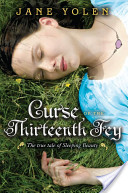
Curse of the Thirteenth Fey: The True Tale of Sleeping Beauty
Jane Yolen, 2012
YA Fantasy


I have a weakness for stories about the fey folk. This particular tale centers around Gorse, the thirteenth and youngest child in a fey family that possesses wings and magical ability. Gorse enjoys frolicking through the fields and studying her elven father’s enormous library of books (some of which are from the future and talk about strange mysteries like “computer science”). Unfortunately, her family is bound to the land of their king and must obey his every summons. Forced to work magic as requested, they reluctantly prepare to attend the christening of the new royal princess and to bring the requisite magical gifts. Gorse has the misfortune to fall into a magical trap that prevents her from obeying the summons. Not only does this put her entire family at risk, but it also lands her in the clutches of an unsavory, Unseelie prince who wants to use her to escape his own enchantment.

This story plays with folk and fairy tale conventions in a pleasant, light-hearted way. The fey folk (Seelie, Unseelie, and Family) are traditional enough to contrast well with the modern structure of the story. The Sleeping Beauty element is turned on its head in a manner that is not particularly unpredictable but is humorous.  Although the tale is light and fluffy, it provides a positive take on family love and loyalty, the importance of learning, and the unpredictability of prophesies. This is a harmless, enjoyable book that young teen girls would enjoy.


Thursday, March 28, 2013

Fantasy Warfare and Gender Realism


Our culture’s desire for equality has drastically changed the stories we tell. Even modern editions of Richard Scary’s picture books (as opposed to the original editions from the 1960’s) are altered: note that the genders of most of the animals on this book cover have been reversed so as to make the point that daddy helps with breakfast and that women are policebears, too.  Yet despite the strides our culture has made in erasing traditional gender roles, a sense of urgency remains, and storytellers feel morally compelled to present readers with the type of gender relationships that are now considered equal.


This puts the writer of fantasy fiction in a challenging position. Although their stories are often set in medieval-style surroundings, modern readers expect women who are strong not only emotionally but also militarily. Yet often this is done in a style that is utterly unrealistic and would be laughable if readers were not so conditioned to expect (and demand) that gender play little role in the physical prowess of fictional characters. When reading (or watching) stories in which women don armor and routinely fight men twice their size, I often long to ask the author why he/she thinks that even liberated, modern women don’t play on male football teams. I am not about to suggest that all female characters in fantasies limit their activities to embroidery and food preparation. However, if authors wish to truly address gender in a meaningful way, they must consider it realistically in conjunction with their worldbuilding. The following points should be considered:

1.      Although women’s physiques provide an advantage over men in some athletic pursuits (swimming across the English channel, for instance), the typical women does not possess the speed, reach, or weight-lifting ability of the typical man. Hence, gender segregation is maintained in professional sports.  If we moderns do not send women to play against men’s football teams, would a culture really send their women against the equivalent male team when the stakes are victory or death?

2.      Before modern medicine, the mortality rate of all populations, especially infants, was high. In addition, humans tend to pair into couples, and in eras without wide-spread birth-control, young women spent a significant amount of time pregnant and nursing.  Would a medieval-style culture really send their young women (their only hope of maintaining a population) into battle?

What is a writer to do? If it is important to your story that women routinely fight alongside men, create a system of weaponry that makes this realistic, or at least deal realistically with the physical implications of women's bodies. In addition, however, the culture must be addressed. What would compel a group of people to send their women into battle, when most humans throughout history have not routinely done so? Consider the fact that until the advent of modern technology, physical strength was so important in daily life that the physical capabilities of men and women remained decisive factors. It is only nowadays, when women really can perform most jobs as easily as men, that the concept of gender equality is accepted. Yet also consider the cultures of the past in which women were treated as possessing the same moral rights as men, or did participate in leadership roles. How do the shaping beliefs of those cultures compare to your own worldbuilding?

Above all, however, I urge writers to broaden their definition of strong women. Why must battle be the only test of moral, mental, and emotional strength? Why must the woman ALWAYS pick up a sword before the story ends? Women throughout time have shown courage in many ways. They have provided medical care, maintained the farms and cities their men fight for, outwitted invaders, and contributed immeasurably to moral by choosing to maintain courageous attitudes. When their world is crushed by enemies, women have helped to build new worlds. It is sexist and blind that many writers and readers do not recognize the power and triumph in these activities. Although there is a time and a place for women to pick up a sword, the writer who does not recognize that combat is only one facet of strength is in danger of narrowing women’s spheres instead of broadening them. This stereotype is maintained when female protagonists reject the “women’s sphere” with contempt, as if all traditionally feminine activities are demeaning, instead of also drawing strength from it. Developing a broad (and realistic) image of gender in stories is important because, despite all of the fantastical elements, fantasies are still about human beings. That is what makes them good stories.

Monday, November 19, 2012

Review: The Eyre Affair

by Jasper Fforde
Hodder and Stoughton, 2001


I laughed hysterically while reading this book, yet I am still trying to decide if I like it.

Fforde presents an alternative version of 1985 Britain in which weird and wacky are the world’s bread and butter. Still locked in the Crimean War with Imperial Russia, Britain is a police-state in which literature and art are closely regulated and play a volatile role (mobs and riots occur over clashes of literary interpretation). Cloned dodos are the pets of choice, the occasional vampire hunts for prey, and history is not immune to change.

Through this world a purely evil villain with mysterious power runs amok, pursued by an intrepid LiteraTec named Thursday Next. Thursday is a weary and somewhat jaded police detective who is nevertheless heroic under fire when necessary. She ultimately follows the villain into the pages of Bronte’s original Jane Eyre manuscript in an attempt to rescue both the novel itself and her kidnapped aunt and uncle.

Is this book well-crafted? It is certainly original, outrageous, and defies the bounds of genre. Absurdities and oddities abound. Even the names are jokes: the character called Jack Schitt is not a pleasant man, and the one called Braxton Hicks is not an effectual man. If one were inclined to be picky, it might be pointed out that most key events in the story occur simply because they are necessary to the plot, not because they flow naturally from the plot. However, the question that really bothers me is this: does Fforde’s wacky use of English literature (in which random chance is the real force behind some of our most beloved classics) display a fondness for those books, or instead an existential disregard for the premise that an author’s intentions provide meaning to their book? Is Fforde on the side of the deconstructionists? Perhaps I have no right to ask such a question of a book that so obviously does not take itself seriously, but the question came unbidden and lingers in my mind. I would love to hear what other, literature-loving readers have to say on this. Therefore, I highly recommend it to all of them.
 
 
Related Posts Plugin for WordPress, Blogger...